
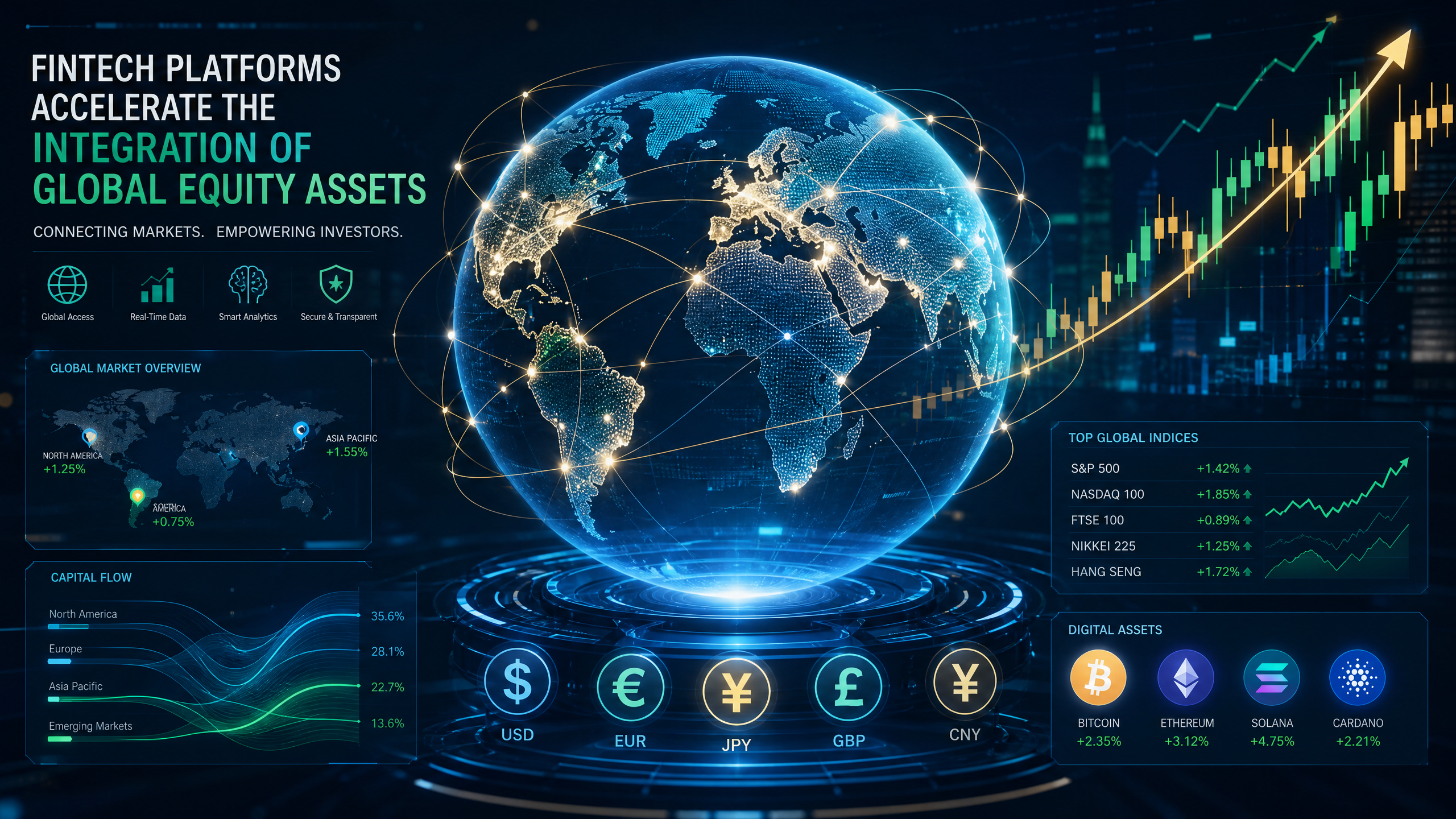
In recent years, with the rapid development of artificial intelligence and metaverse technologies, a number of new platforms have emerged in the fintech sector aiming to integrate global equity assets. These platforms are attempting to use technology to break down traditional barriers to cross-border investing and provide investors with a more convenient channel for global asset allocation.
In the past, individual investors looking to participate in overseas stock markets often had to navigate complex account opening processes, face high cross-border fund transfer costs, and track dynamic information across multiple markets on their own. These barriers long restricted global investing to professional institutions and a small number of high-net-worth individuals.
Today, some fintech platforms have begun digitally integrating equity assets from different countries and exchanges. Users can trade and manage assets across markets including the U.S., Hong Kong, and Japan—all within a single platform, without the need to open separate cross-border accounts. This one-stop model significantly lowers the barriers to global investing, enabling a broader range of investors to participate in global capital markets.
On the information front, the introduction of artificial intelligence is transforming traditional investment research methods. Faced with massive amounts of stock market data from around the world, manual analysis often struggles to balance both breadth and depth.
Reports indicate that some platforms have deployed AI-driven data analytics systems capable of scanning global stock markets in real time, automatically screening investment targets with growth potential, and conducting multi-dimensional analysis of industry trends, company fundamentals, and market sentiment. Compared to traditional research, AI systems offer clear advantages in information coverage and processing efficiency, helping investors identify opportunities and direction more quickly.
In terms of business model innovation, some platforms have introduced the concept of ecosystem assets. By holding specific ecosystem assets, users can not only participate in platform revenue distribution but also exercise voting rights on major ecosystem development matters.
The design intent behind this mechanism is to deeply align platform growth with user interests. As platforms increase in value through technological innovation and user base expansion, early participants and active users can directly share in the value generated by this growth. This co-creation model offers new possibilities for building long-term, healthy user relationships within the fintech industry.
From a longer-term technological evolution perspective, the realization of metaverse concepts is expected to further transform the investment experience. As virtual reality and digital twin technologies mature, investors may one day be able to enter immersive virtual trading spaces as digital identities.
In such scenarios, investors could view real-time dynamics across global exchanges, conduct interactive analysis with AI assistants, and even exchange insights with other investors within virtual spaces. This shift from two-dimensional interfaces to three-dimensional spaces promises to make investment decisions more intuitive and efficient.
Currently, fintech platforms are transitioning from standalone trading tools toward comprehensive digital financial infrastructure. By integrating global assets, embedding AI capabilities, and exploring ecosystem mechanisms, these platforms are attempting to build a unified digital space connecting global capital markets.
Industry observers believe this trend is still in its early stages of development, but its pace of evolution warrants continued attention. As technology matures and user acceptance gradually increases, the way global capital markets operate is expected to undergo even more profound changes.

The Metaverse Finance Association is a global organization dedicated to promoting the development and standardization of the metaverse finance industry.